
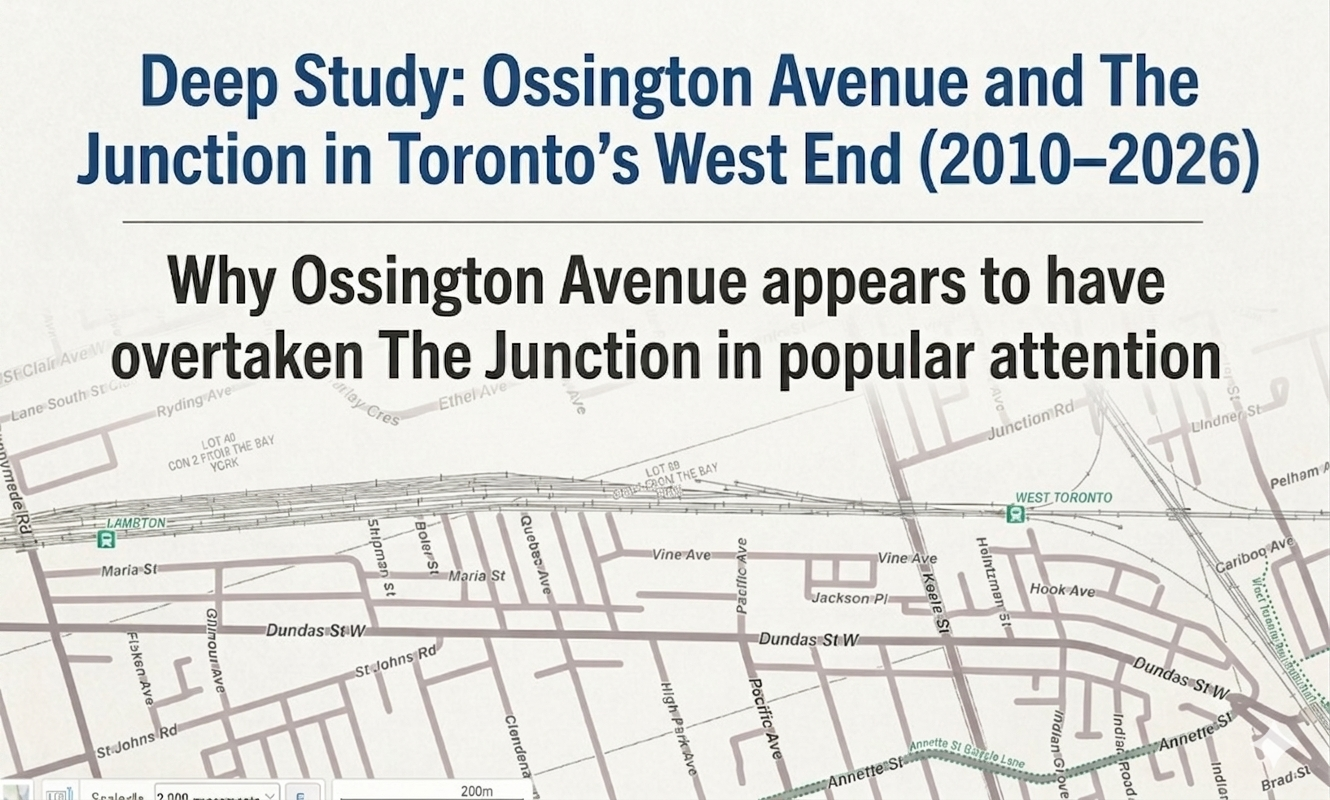
Deep Study: Ossington Avenue and The Junction in Toronto’s West End (2010–2025)
Why Ossington Avenue appears to have overtaken The Junction in popular attention
In this 1st post, a look is taken as to what happened and why, the 2nd post (upcoming), calls back memories of issues and achievements of Junction residents to make great changes for good and life in the community.
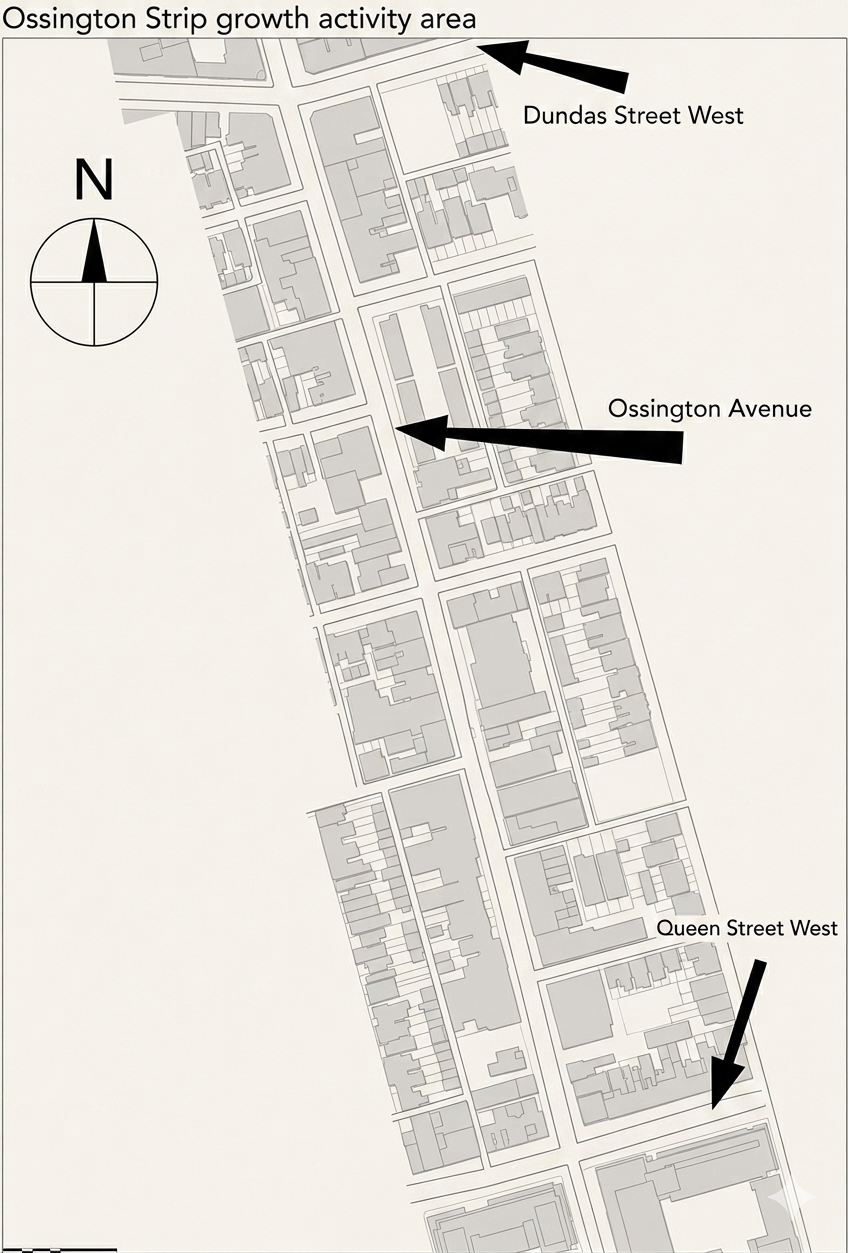
Ossington Avenue (the strip between Queen Street West and Dundas Street West) and The Junction (centred around Dundas Street West, Keele Street, and Pacific Avenue) have both undergone significant change over the last 15 years. Both were once gritty, industrial, or working-class areas that experienced gentrification and can still be descriped as gritty still. Public opinion, media coverage, and local buzz, however, have increasingly positioned Ossington as a “must-visit” destination while The Junction is seen as quieter and more neighbourhood-focused and not a place to visit. yet is commonly reviewed a great plave to live. This spost examines the transformation of each area from 2010 to 2025 and tries to explain the reasons for the difference in popular attention.
More importantly over a few blog posts, determine a few helpful changes that can be made to enchance the Junction both as a exciting commerical and cutural venue..
Ossington Avenue: From Quiet Strip to Global “Cool Street”
Before 2010, the lower Ossington strip was known for auto garages, (some who had moved from the Junction, One being the on which sat for decades on the North west corner of Vine St and Pacific Ave.), Vietnamese restaurants, and a low-key mix of immigrant businesses. Chnage began slowly in the late 2000s with the arrival of independent bars and shops.
- 2008–2009: Venues such as the Lower Ossington Theatre and early bars like Communists Daughter opened, drawing creative crowds.
- 2010: The City lifted a short-lived moratorium on new bar and restaurant licences, sparking a rapid influx of independent eateries, craft spots, and live-music venues.
- 2012–2018: The area filled with restaurants, vintage shops, and nightspots. Media began calling it a “hipster enclave” and a nightlife hub.
- 2020–2025: Even during the pandemic, investment continued. Retail vacancies dropped to record lows. In 2022, Time Out magazine ranked Ossington Avenue 14th on its list of the 33 coolest streets in the world, praising its restaurants, nightly live music, and walkable, approachable vibe. By 2025, major brands were using the strip as a testing ground, and demand for retail space remained extremely high.
The strip’s compact size (easy to walk end-to-end) and pedestrian-friendly redesign helped it become a concentrated destination rather than just a residential area.
The Junction: Steady Change with a Stronger Neighbourhood Focus
The Junction (the area around Dundas West, Keele, and Pacific) has a long industrial history. It was known for factories, stockyards, and a strict alcohol prohibition that lasted until 2000. Revitalization started earlier than Ossington’s but progressed slowly and is still ongoing:
- 1990s–early 2000s: Stockyards redevelopment and street improvements began. The end of prohibition in 2000 allowed bars and restaurants to open.
- 2010–2015: Breweries, art galleries, and small businesses moved in. The neighbourhood gained a reputation for maker spaces, community festivals (such as the Junction Summer Solstice Festival), and a mix of housing types.
- 2014–2017: Academic studies and local reports noted ongoing gentrification, rising housing prices, and some displacement of longer-term residents. However, the area kept more of its “small-town charm” and multi-generational feel.
- 2018–2026: Development continued with new housing, retail, and heritage projects. The Junction Triangle remained liveable with parks, local businesses, and a strong sense of community identity, but it never received the same level of city-wide or international media spotlight as Ossington.
While The Junction saw real economic and cultural growth, its larger geographic spread and more residential character meant it never became a single “strip” destination in the same way.
Direct Comparison: Why Ossington Overtook The Junction in Popular Attention
Both neighbourhoods gentrified and improved between 2010 and 2026, but Ossington captured far more public imagination and media coverage. Here are the main reasons:
| Factor | Ossington Avenue | The Junction |
|---|---|---|
| Scale & Layout | Compact linear “strip” — easy to walk and market as one destination | Broader neighbourhood spread over several blocks |
| Nightlife & Food Scene | Explosive growth after 2010; became known for bars, live music, and restaurants | Breweries and casual spots, but quieter and more neighbourhood-oriented |
| Media Recognition | Global coverage (Time Out “coolest streets” 2022); frequent features in Toronto media | Mostly local heritage and community stories; fewer “hot spot” headlines |
| Timing of Boom | Sharp acceleration 2010–2015 with bar licence changes | Slower, steadier change starting in the early 2000s |
| Location Advantage | Closer to Queen West and core West End scenes; high visibility | Further west; feels more like an ou of core area |
| Public Perception | “Hip,” “cool,” “destination” vibe | “Charming,” “historic,” “liveable” but less buzz |
Ossington benefited from: a concentrated, walkable layout that lent itself to nightlife, timely policy changes that unlocked new businesses, and strong media amplification that turned it into a city-wide (and even global) symbol of cool Toronto.
The Junction experienced genuine revitalization and retained a stronger sense of community and history, but its broader scale and more subdued pace meant it never generated the same concentrated.
Public opinion in Toronto seems now to treat Ossington as a special, unique strip worth visiting, while The Junction is respected as a solid, evolving neighbourhood.

