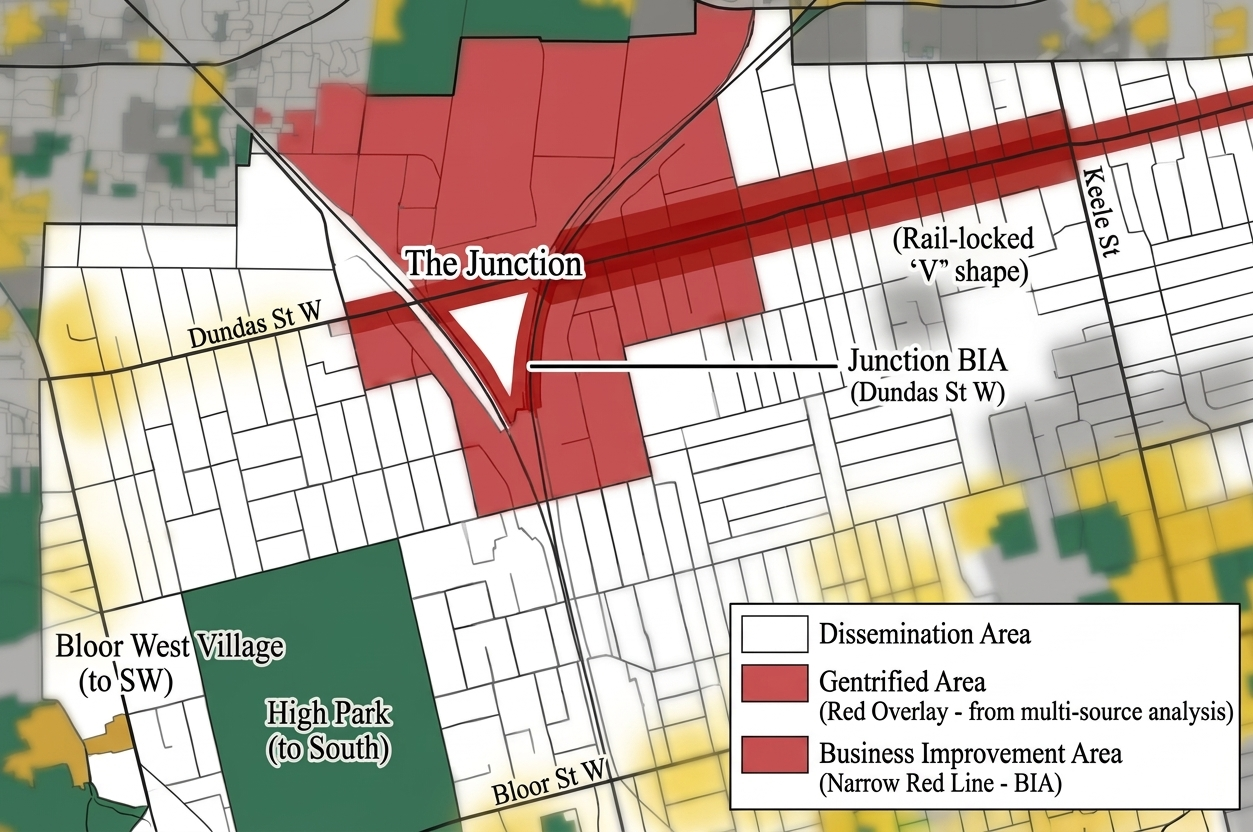
The Junction is so often described as a gentrified neighbourhood, yet why does the community still see so many empty storefronts and a constant churn of restaurants?
While gentrification can increase property values and attract investment, it does not automatically create a healthy business environment. Rising commercial rents can make it difficult for small independent businesses to survive. Property speculation can also play a role. Some commercial spaces are held by owners who expect future increases in value. Rather than reducing rents to attract tenants, they may choose to leave spaces vacant while waiting for higher returns.
The answer may lie in the difference between residential success and commercial stability.
While gentrification can increase property values and attract investment, it does not automatically create a healthy business environment.
1. Top Left Map: Freeman (2005) Gentrification Measure
-
Classification: Gentrified (Red)
-
Details: Under Lance Freeman’s widely utilized method—which typically flags neighborhoods that started with lower-than-median incomes and subsequently saw rapid increases in housing prices and college-educated residents—the Census Tract encompassing the core Junction area is explicitly highlighted in red.
2. Top Map (generated by the blog) based on : Ding et al. (2016) Gentrification Measure
-
Gentrified (Red) Details: Under the Ding et al. index—which handles gentrification thresholds, often capturing deeper or more sustained waves of residential and socioeconomic displacement—the Junction is still firmly classified as gentrified. In fact, this index captures a slightly broader contiguous block of red sweeping through the west end.
3. Inset Business Improvement Area (BIA) Layer
-
Classification: Business Improvement Area (Dark Red)
-
Details: This map in dark Red shows the main section of the Junction’s main commercial spine (Dundas Street West) shows up as a distinct, linear red strip cutting right through the middle of the neighborhood’s residential tract.
Gentrification does not automatically create commercial stability. In fact, the very forces that qualify a neighborhood as gentrified on paper can actually trigger a chaotic cycle of high commercial turnover and empty retail spaces.
Here is why the Junction May experience retail strength issues despite its gentrified status:
Rent Speculation
When generified under indices like Freeman or Ding property values increase. Commercial landlords and developers look at the changing demographics and raise retail rents to match expected future wealth rather than current reality.
-
The Result: Independent, community-staple businesses get priced out.
-
The Vacancy Cycle: Landlords may rather leave a storefront empty for months or years holding out for a corporate tenant or a high paying franchise than lower the rent and lock into a long-term lease with a lower-paying local tenant.
-
Daytime vs. Nighttime Foot Traffic
Gentrification often attracts a younger demographic or professional families who commute out of the neighborhood for work. While the Junction’s Dundas Street West strip might buzz on Friday nights and weekend mornings, weekday daytime foot traffic can be deceptively quiet.